

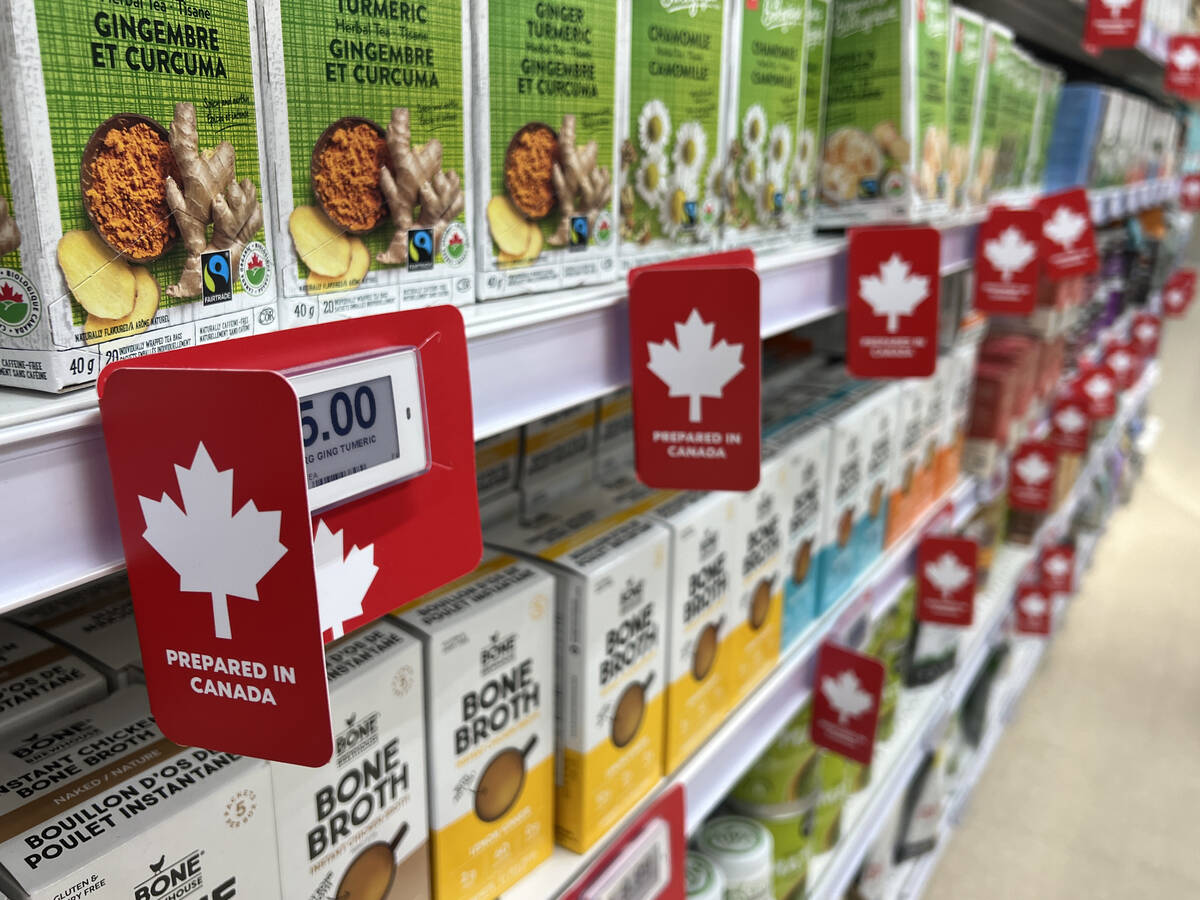
Countless surveys have told us that Canadians want to buy Canadian.
They say they want to support local farmers and processors, keep dollars at home and protect jobs.
However, when standing in front of the grocery shelf, good intentions often give way to convenience and price.
Read Also

Strychnine should not be seen as a silver bullet for gophers
The emergency registration of strychnine for control of gophers in specified areas of Alberta and Saskatchewan may actually hamper control of the rodents.
That contradiction, however, seems to be fading, and geopolitics has a lot to do with it.
According to the latest NIQ (formerly NielsenIQ) retail data, sales of “Made in Canada” food products are up more than 10 per cent year-over-year as of September 2025, while U.S.-made products are down nearly nine per cent.
This trend has persisted for more than six months. In the world of consumer data, that’s not a blip — it’s a shift. Canadians aren’t just saying they want to buy Canadian; they’re actually doing it.
Turn on the television any night and there’s one recurring face: Donald Trump. Canadians, whether they follow U.S. politics closely or not, are constantly reminded of his message of America First.
And consciously or not, they’re responding. Every fiery clip about tariffs, immigration or foreign competition reinforces the sense that Canada needs to rely on itself.
Buying Canadian food has become a quiet, patriotic act and a statement of self-reliance in an uncertain world.
When cross-border relations feel tense, the grocery store becomes a symbolic space of control. Each jar of Canadian jam, each bag of local flour, feels like a vote for stability and identity.
The “Buy Canadian” idea isn’t new, but for years, it mainly lived in our rhetoric.
The North American market blurred origins, and few shoppers bothered to read the fine print.
Since early 2025, however, both “Made in Canada” and “Product of Canada” categories, which differ in how much of the ingredients and processing are domestic, have shown consistent growth, while U.S. imports have posted negative sales for seven straight months.
This new grocery patriotism, however, also raises a difficult question: at what cost?
When consumers focus narrowly on national origin, market competition can narrow, too. If buying Canadian becomes more about sentiment than value, we risk paying more, sometimes for products that aren’t necessarily better or more sustainable.
It’s worth asking whether this wave of food nationalism, however well-intentioned, has contributed to higher prices. The more insulated our food market becomes, the greater the risk of inefficiency and complacency.
Canada’s agri-food sector is remarkably diverse and resilient, but we can’t grow or process everything efficiently. Pretending otherwise is economically naive.
Self-reliance must not become self-restriction. If this patriotic shift is to benefit Canadians, it needs to be guided by our comparative advantages rather than emotional reflexes.
Our grain, seafood, livestock and pulse sectors are world-class. Our innovation in food safety, traceability and clean processing is globally admired. That’s where national energy should go: doubling down on what we do best rather than trying to replace what others already do well.
Instead of equating “Canadian” with “expensive,” our food economy should aim to make “Canadian” synonymous with quality, efficiency and innovation. That’s the formula that will keep domestic production competitive while allowing consumers real choice at the shelf.
This is not a call to abandon local pride. In fact, it is far from it. A strong domestic food base is vital for resilience.
However, the challenge for Canada is to balance patriotic consumption with global pragmatism. We should buy Canadian when it makes sense, trade when it benefits us and stay open to the world.
Sylvain Charlebois is senior director of the Agri-Food Analytics Lab at Dalhousie University. This article first appeared on the TroyMedia website. It was edited for length.