
Agricultural powerhouse Brazil is investing heavily in expanding production and improving its export infrastructure and appears to have few qualms about accepting Chinese investment to reach its goals.
The United States and China are locked in competition over global dominance, restricting any Chinese investment in America.
Canada is also worried about China’s global strategic strategy and is highly suspicious of Chinese investment.
Read Also
Farm practices must respond to soaring fertilizer prices
The rising cost of production has changed the conversation on whether the time is right for farms to improve their precision agriculture practices.
But Brazil is accepting tens of billions in Chinese investment to expand its railways and ports.
The old tongue in cheek recommendation to buy land because they aren’t making any more doesn’t apply to Brazil’s agricultural farm acres.
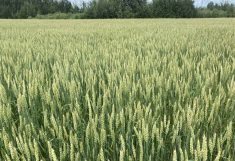
Since 2000, harvested soybean area has risen 350 per cent to 120.6 million acres from 34.4 million, and the corn harvested area climbed 174 per cent to 55.8 million acres from 32.1 million.
Brazil’s yields have also grown, so productivity growth is not only due to acreage development.
However, there is no intention to stop there.
Embrapa, Brazil’s state-owned agricultural research company, estimates that 69 million acres, or 17 per cent, of Brazil’s pastures could be converted to row crop production.
Brazilian bank Itau BBA estimated this conversion could help the country raise soybean production to 275 million tonnes from about 170 million now, and corn production could climb to 227 million tonnes from 144 million.
However, one of Brazil’s weaknesses is its transportation system.
Rail lines are underdeveloped. The country once had 30,000 kilometres of rail lines but that is down to 12,000 km and mostly focused on moving iron ore, according to Luís Valdez, president of the country’s Association of Cargo Transport Users in an interview with BNamericas.
More than half of the country’s soybeans and corn move to port on trucks.
Until recently, some key highways linking newly developed agricultural areas to ports were not paved.
However, that is changing with a new push to building railways and expanding ports, with the help of Chinese investment.
In 2015, China and Brazil began to sign multibillion-dollar funding agreements for transportation infrastructure, energy, mining, agriculture and other projects, such as Chinese electric car company BYD, which recently opened a technically sophisticated $1 billion EV factory in Bahia state.
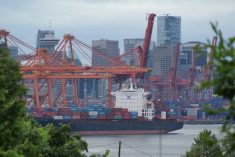
Chinese company investment is already improving Brazil’s ports.
China’s state-owned agriculture company COFCO is spending about US$285 million on a grain terminal at the Port of Santos that is capable of exporting up to 14 million tonnes a year.
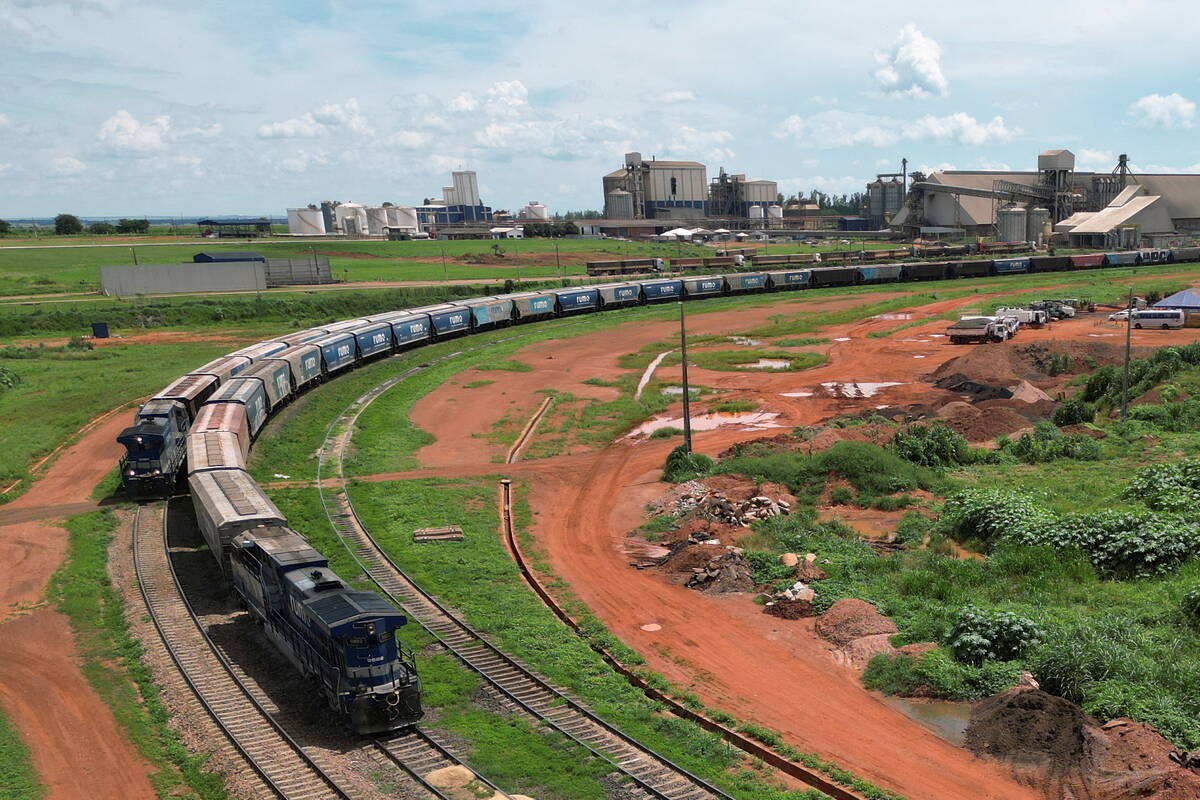
COFCO is also investing $240 million, in collaboration with Rumo, Brazil’s largest railway logistics company, to buy 23 locomotives and almost 1,000 rail cars to meet rising demand to service Santos.
Rumo and the state of Mato Grosso are building a 730 km line to extend freight rail service into the agricultural heartland of the state and link it to existing lines feeding into Santos port near the country’s largest city, Sao Paulo.
Brazil’s government is expected to set out a plan early in 2026 for about $18 billion in railway projects to further connect agricultural regions in the west to ports in the east.
These rail extensions into farm lands, if they go ahead and are complete in several years, would vastly lower the cost of movement and cut greenhouse gas emissions of transportation.
Another rail project in the concept stage is much larger, and China is directly involved.
This summer, Brazil and China signed a memorandum of understanding to study the feasibility of a transcontinental railway linking Peru’s Pacific coast with Brazil’s Atlantic coast.
A Chinese railway research institute will work with Brazil’s department of transportation on the feasibility of the Bioceanic Corridor, looking at technical, economic, logistical and environmental factors.
If constructed, it would shorten export times from Brazil to Asia by up to 10 days.
The Pacific terminus would be Chancay Port, 80 kilometres north of Peru’s largest city, Lima.
The deep water port that opened in 2024 and cost $3.5 billion is described as a highly automated mega port and is majority-owned by China’s COSCO Shipping along with minority owner Volcan, a Peruvian mining company.
Of course, there is a wide gap between proposals and project completions. Environmental and Indigenous groups have used political pressure and the courts to force changes, create delays and stop projects in the past and could do so again.
There is much concern domestically and internationally about development damaging the Amazon and Cerrado savanna.
Brazil is a member of BRICS, the geopolitical bloc of Brazil, Russia, India, China and South Africa, and now also Egypt, Ethiopia, Indonesia and the United Arab Emirates.
They meet annually for formal summits and co-ordinate multilateral policies and are sometimes described as an alternative to the G7.
Brazil also courts investors from the U.S., Canada and elsewhere, but expect its linkages with China to continue to grow as it seeks to offset U.S. president Donald Trump’s tariffs and increasingly belligerent foreign policy.