
Canada is keen to convince China to end its 25 per cent tariff on Canadian pork imports, but as the Asian giant struggles to address a huge pork oversupply, resolution of the trade dispute is likely a low priority in Beijing.
Federal finance minister François-Philippe Champagne was recently in China, meeting with Chinese vice-premier He Lifeng about pork, energy and other issues.
The meeting happened as the surplus caused retail pork prices there to drop to an eight year low. Cash hog prices are down 30 per cent from last year and are at a 16-year low, according to Chinese markets information provider JCI.
Read Also
United Nations warns of food crisis; others not convinced
SASKATOON — A leading U.S. grain market analyst does not put much stock in reports of a looming food crisis…
Chinese pig producers are losing money hand over fist, hit by a double whammy of falling hog prices and rising costs of feed and other inputs, such as amino acids and vitamins caused by the war in Iran and the closure of the Strait of Hormuz.
Also, pork demand is off as consumers complain about the taste of the mass-produced pigs.
Pork is crucial to China
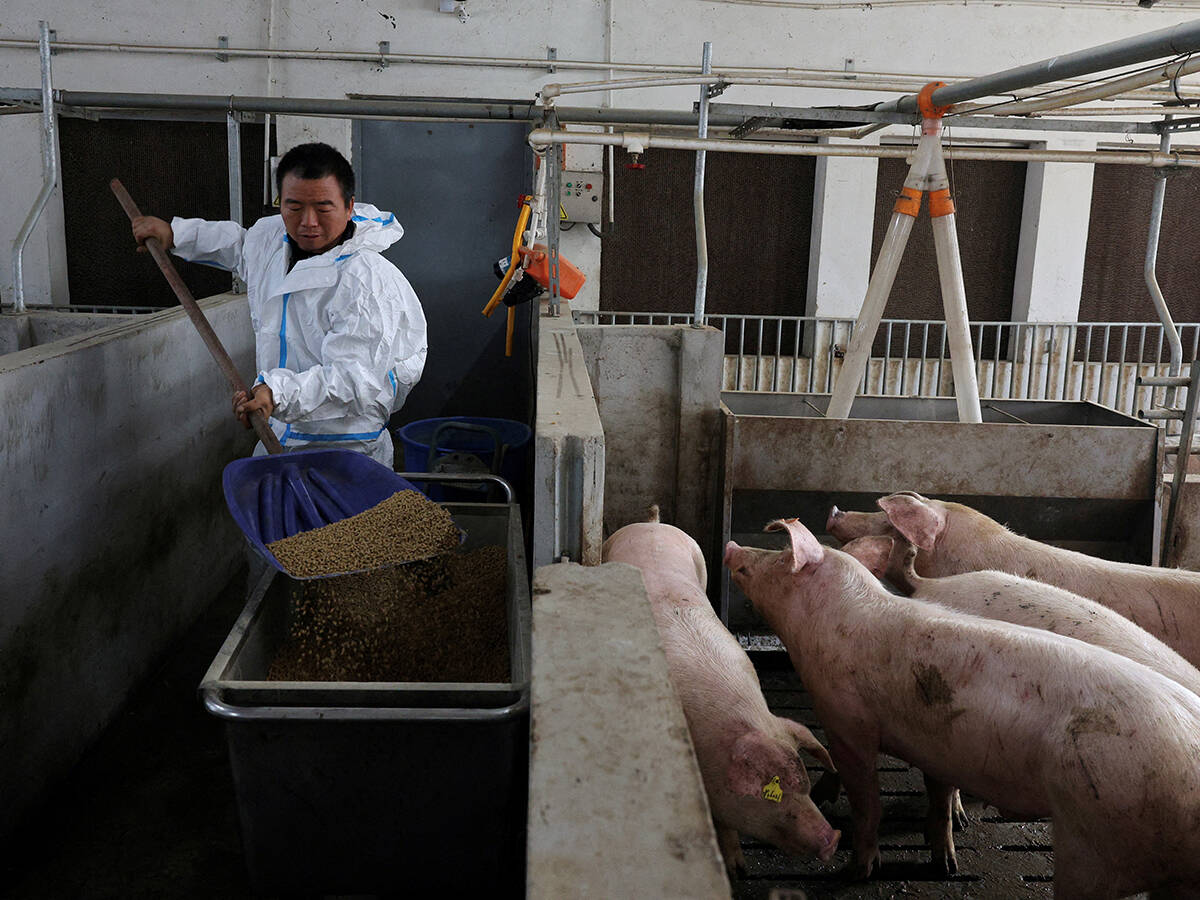
China has about half of all the pigs on the planet, and over the last decade, there has been massive upheavals in the industry, from African swine fever, which prompted huge culls, pork shortages and soaring imports, to a massive consolidation into giant industrial farms with multi-storey barns.
These industrial operations have now over-expanded.
Last summer, Beijing gathered the industry to demand herd trimming. The summer sow-breeding herd stood at about 40.5 million head, above the target of 39 million.
The breeding herd has fallen slightly but remains too large, creating an excess of market pigs.
Even as Beijing tried to restrict herd growth, the largest producers expanded to improve efficiencies of scale and drive smaller producers out of business.
With a surplus of domestic pork available, pork imports have fallen.
Pork imports are down
Chinese customs reports pork imports for January and February totalled 310,000 tonnes, down 19 per cent from the same period last year.
The tariff on Canadian pork means this country is particularly affected.
Agriculture Canada’s red meat data page shows Canada exported slightly less than 9,000 tonnes to China in January, down 50 per cent from the same month last year.
U.S. pork does not currently face tariffs, but its exports to China in January and February combined were down 12 per cent by tonnage.
China levies tariffs of 4.9 to 19.8 per cent on pork from the European Union. China says European pork is dumped at prices below production costs or domestic market prices.
EU pork exports to China in January fell 26 per cent to 76,267 tonnes.
I couldn’t find statistics for Brazilan exports this year.
As noted, China’s central government is trying to settle the market.
In addition to encouraging herd reduction, it is discouraging the practice of smaller producers engaging in “second fattening,” in which they buy fed hogs and feed them to gain additional weight before selling them to packers.
However, so far the actions have not had the desired effect.
Retired U.S. Department of Agriculture economist Fred Gale in his DimSums blog on Chinese rural policy in February reported that the mega hog producers are expanding as well as investing through the value chain, including grain storage, procurement, trucking and shipping.
China produces a lot of pork
The size of these mega producers is astounding.
The largest, Muyuan Foodstuff, produced almost 78 million head in 2025, up 6.4 million from the previous year.
Canada’s hog producers collectively produced only about 25.5 million.
The second largest producer is Wens at 40 million head, up 10.3 million from the previous year, and third is Twins at 26.5 million, up 8.7 million, according to the DimSums blog.
Almost the only companies to produce fewer hogs in 2025 were those generating one million head or fewer.
Lower pork prices might seem a boon for consumers, but it is part of a larger problem of deflation in China.
China might be an economic miracle, but its long run of growth is in danger.
Large sections of its economy and real estate markets are overbuilt and supply outstrips demand, leading to lower prices.
Corporate profits are down, bad debt is blooming and unemployment is rising.
It is very far from collapse, but it is troubled.
What does this mean for Canadian farmers?
It is hard to judge all the implications for Canadian farmers.
It is clear that China won’t be a big buyer of Canadian pork for the foreseeable future.
The Chinese hog herd is the biggest consumer of soybeans in the world, and soybean markets are tied to canola.
Beijing has reduced its reliance on imports of American soybeans, buying more now from Brazil.
It also tried to get hog producers to include more domestic feedstuffs.
It has had some success in getting hog producers to get more of their protein needs from fermented domestic feedstuffs.
Its overall demand for imported soybeans is unlikely to shrink in the near term, but its rate of growth is declining sharply.