

John Bottomley wants people to know there’s more to renewable fuel than ethanol.
“As a society we seem to get hung up on specific technologies …. There is no silver bullet,” said Bottomley, president of Outlook Resources, an alternative energy company with its head office in Selkirk, Man.
“This whole thing with renewables, it’s not going to be just one solution.”
Outlook Resources has moved closer to providing a different form of renewable energy, announcing Feb. 14 that it plans to build a 400 ton per day biomass cubing plant near Rosser, Man., just north of Winnipeg.
Read Also
How Saskatchewan’s satellite forage insurance program is going to work
Saskatchewan Crop Insurance Corp.’s Satellite Forage Insurance Program is officially underway, having replaced the Forage Rainfall Insurance Program.
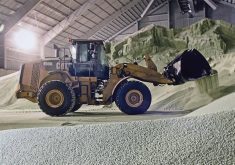
The facility will process agricultural biomass and recycled products into cubes that can be burned like coal.
To that end, Bottomley has signed an agreement with BFI Canada to lease its recycling facility at Rosser. The deal will ensure a 200 ton per day supply of wood, cardboard and paper waste for the biomass cubing plant, which will be operated by Prairie Bio Energy, a subsidiary of Outlook Resources.
“We are extremely pleased to have reached this agreement with BFI Canada,” Bottomley said in a news release.
It has been a busy winter for Outlook Resources. In late January, it announced it had acquired a 75 percent stake in Prairie Bio Energy for $750,000 and four million shares of Outlook.
Prairie Bio Energy president Stephane Gauthier and executive vice-president Eugene Gala will continue to lead the company, which has operated a 100 ton per day biomass cubing plant near La Broquerie, Man., since 2005. It will be dismantled and moved to Rosser.
Gauthier said the deal was necessary because big players will likely soon dominate the renewable energy field.
“We thought we had to move pretty quick, as far as growth … so we started looking for other investment,” said Gauthier, a graduate of the mechanical engineering program at Red River College in Winnipeg.
As well, Gauthier said, the business models of the two companies are similar.
“We saw a very good fit and John likes our philosophy of using waste and residue material rather than going into the energy crops,” he said.
Gauthier and Gala, also an engineer, developed a technology that compresses a blend of wood and paper waste and crop residues, including flax and canola straw, into 2.5 by two centimetre fuel cubes.
“It’s a direct substitute for coal and typically not for residential, but for the larger (commercial) systems,” Gauthier said during an interview from his home in La Broquerie.
He said the cubes produce 7,500 BTU per pound, which is 10 to 20 percent more than lignite coal.
Prairie Bio Energy’s clients include hog barns, Hutterite colonies and pulp and paper mills.