

Attaching weights to a tractor to improve traction or balance load capacity is a common practice.
Options typically include bolting weights onto a tractor’s rear wheels or adding suitcase-type weights to a mounting bracket at the front of a tractor to balance out a load.
Read Also

Selecting IDC-tolerant soybeans does not reduce yield, Manitoba study confirms
University of Manitoba research shows soybean varieties selected for iron deficiency chlorosis (IDC) tolerance protect yield in affected areas without reducing performance elsewhere in the field.
However, each approach invites at least two problems: weights are physically heavy to move and could cause accidental injury, and the weight is not balanced over the tractor frame.
At Agritechnica in Hanover, Germany, last November, Laforge had a product on the show floor designed to eliminate these concerns.
You can find all our Agritechnica 2025 coverage here.
About 10 years ago, the France-headquartered company collaborated with John Deere to design a balanced weight system for its 7R tractors.
The result was EZ Ballast, an easy-on, easy-off weight system that places up to 1,700 kilograms at the centre of the undercarriage on the tractor’s frame.
Laforge now offers the EZ Ballast for John Deere 6R tractors as well.
“The challenge with ballast is farmers tend to add ballast, wheel weights or front weights when they need weight on the tractor, but then never take them away because it’s too cumbersome,” said Hervé Defrancq, chief executive officer of Laforge.
To hook up the weight, a tractor operator drives over the weight and lowers a catching arm to lift it off the ground. Once the catching arm is in place, the operator lifts the plate into the undercarriage using the tractor’s hydraulics.
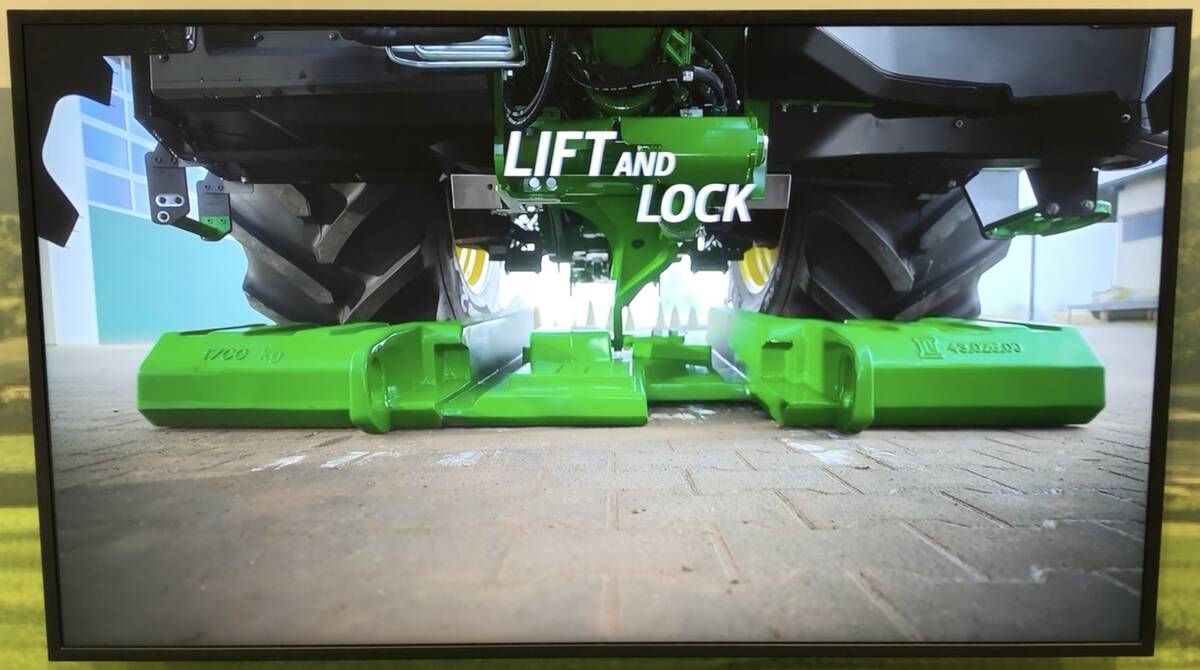
Once the weight is in position, a green LED light confirms it’s locked into place and an operator drives away. To detach the weight, the process is essentially reversed.
“It has much more safety and comfort,” said Defrancq.
“You don’t need to get in and out of the cab as well, and it’s much better weight balance for the tractor.”
Laforge mostly sells the EZ Ballast system to John Deere dealers in Europe, but it does have a distribution centre in Iowa as interest in the product grows.
Installation of EZ Ballast for 6R and 7R tractors is typically done at a dealer.