

WINNIPEG — In 2023, the international market for seeds was worth US$53.5 billion, and about three per cent of that market is canola seed — that is, seeds sold to farmers for seeding.
The $53.5 billion number comes from Axel Diederichsen, who spoke in early December at Canola Week, a Canola Council of Canada event held in Saskatoon.
Diederichsen, who manages the national seed gene bank in Saskatoon, obtained that estimate from S&P Global Commodity Insights, a research firm.
Read Also
Red lentils priced higher than large greens
Red lentil prices have eclipsed large green lentil prices for the first time since 2014.
Given the rate of inflation, that $53.5 billion figure has climbed higher in the last two years, possibly hitting $60 billion.
Why it Matters: Seed for sowing is a massive business and employs tens of thousands of Canadians.
Focusing on Canada, the Western Producer has estimated that farmers bought $1.84 billion worth of canola seed in 2025.
That figure comes from the price per acre of seed and the acreage of canola in 2025.
Saskatchewan Agriculture, in its 2025 Crop Planning Guide, pegged the cost of canola seed at $87 per acre.
Data from Alberta Agriculture confirms that price is in the ballpark. In 2024, canola seed was selling for more than $800 per bag in Alberta. One bag covers about 10 acres, so the price was above $80 per acre.
The Western Producer used $85 per acre as the price to calculate annual sales of canola seed:
Canada had 21.6 million acres of canola in 2025.
21.6 million acres x $85 per acre = $1.84 billion worth of canola seed sold to farmers.
Comparing that estimate to a market report, the global seed market for canola (for seeding) was C$2.7 billion in 2025, says Mordor Intelligence.
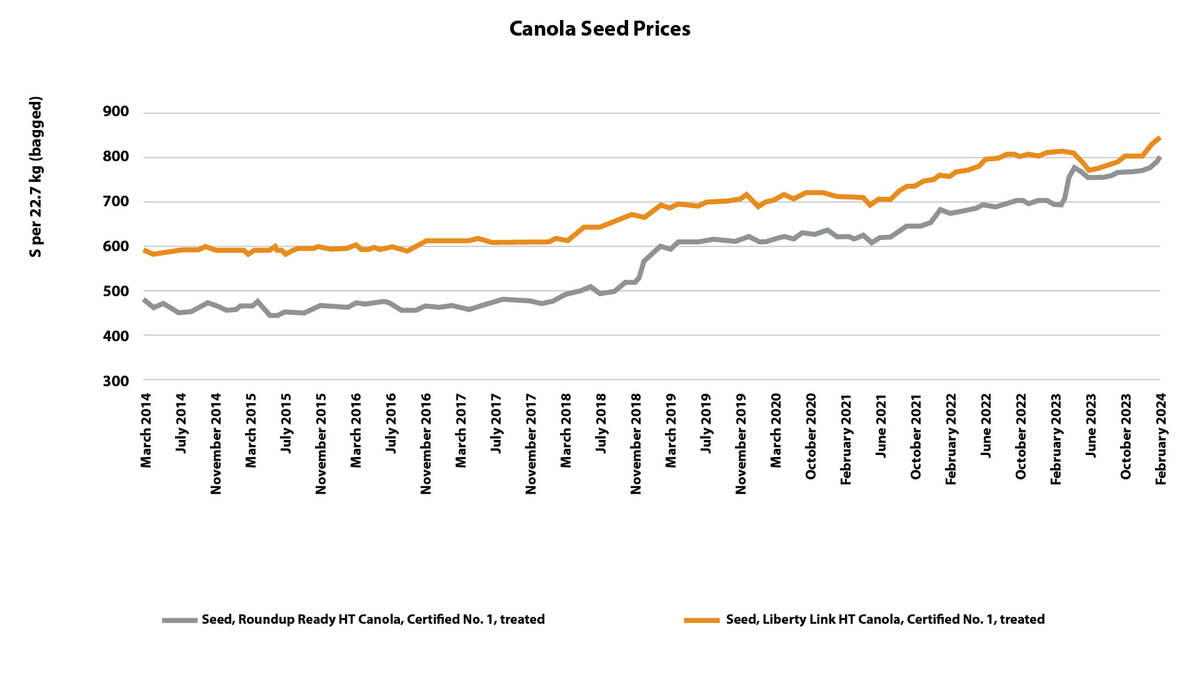
When 2025 is compared to five years ago, Prairie farmers possibly spent about $1.4 billion on canola seed in 2020. That’s assuming 21 million acres of canola and a seed cost of $67 per acre, from Saskatchewan’s Crop Planning Guide.
The increase in canola seed prices and the total amount spent on seed reflects the reality that developing new hybrids has become more expensive.
“Production of certified seed is a meticulous and resource-intensive process, which significantly impacts price,” Azam Nikzad, a market analyst and researcher with the Alberta government, said in the 2024 document.
A 30 per cent jump in canola seed costs isn’t shocking because the price of equipment, parts, fertilizer and other farm inputs has exploded in the 2020s.
“There’s a lot of inflation in everything,” said Darren Bond, a farm management specialist with Manitoba Agriculture, who farms in Manitoba’s Interlake region.
“We priced out tracks on a tractor…. In the fall of 2020, they were $10,500 per track. In spring of 2025. they were exactly double (in price).”
Like Saskatchewan, Manitoba Agriculture produces cost of production estimates for crops every year.
In some good news for farmers, canola seed prices are not increasing in 2026, Bond said.
“We’re doing our 2026 cost of production (report) now. From 2025 to 2026, the canola seed cost was flat. We’ve had some run up and now it’s flattened out (in the last year).”