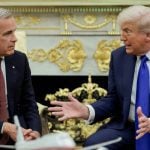

Federal agriculture minister Andy Mitchell says although Canada does not have intervenor status in the Montana courtroom where the BSE border closing issue will be argued in late July, he is convinced the United States government will adequately present the case for Canada.
On June 17, he was in Washington for an hour-long meeting with U.S. agriculture secretary Mike Johanns to review preparations for the court case July 27 when district judge Richard Cebull will consider arguments about whether to make the border closing permanent and more extensive.
Read Also

Manitoba community projects get support from HyLife
HyLife Fun Days 2025 donated $35,000 each to recreation and housing projects in Killarney, Steinach and Neepawa earlier this fall.
“I believe the United States will make our case well,” Mitchell said June 20. “The reality is we have similar positions. Both of us believe the science dictates that the inspection systems are similar, the product is safe and the border should be open.”
The federal government has been granted permission to file an amicus curiae (friend of the court) brief to an appeals court in California that will be asked in mid-July to overturn Cebull’s temporary injunction against a border opening.
However, the Montana judge refused a Canadian government request to file a brief in his court for the July 27 hearing.
The government did not appeal that ruling and will rely on USDA lawyers to argue the open border case.
The Conservative party caucus announced June 20 it has been given the right by judge Cebull to file a brief in his court before the July 27 hearing.
However, he turned down the application of the 70 Conservative MPs and senators to have a lawyer with intervenor status, able to question witnesses.
“The final objective of the USDA and members of Parliament is exactly the same in this case,” the Montana judge ruled June 17.
“Members of Parliament have not shown why the USDA cannot be expected to vigorously defend the interests of MPs in having the USDA’s final rule (to open the border) remain in effect. Therefore, allowing intervention of MPs would be pointless and would cause even greater complications and impose heavier burdens on the court as the case develops.”
Still, Conservatives at a June 20 news conference and in the House of Commons bragged that their brief to the U.S. court is “unprecedented” for an opposition party and is happening only because the Liberal government is not there.
“The security of Canada’s beef safety system will be on trial in a Montana court,” agriculture critic Diane Finley said in the Commons June 20.
“Can the minister of agriculture explain to Canadian cattle and livestock producers why he has left it to the official opposition to do the government’s job of defending Canada’s farmers in international courts?”
Mitchell said the government will have a presence at the appeals court two weeks before the Montana hearing.
“Where the rest of these members may have been here cackling with one another and throwing insults across the aisle, I was in Washington Friday working with the USDA to in fact get the border open,” he told Lethbridge Conservative MP Rick Casson.
In an interview, Mitchell said he and Johanns briefly discussed the fact that tests are under way to determine if an American cow first examined in November may have had BSE.
“I think clearly that with the USDA regulatory system, as well as ours, we agree there is likely a low and declining number of BSE cases in the North American herd,” he said.
Casson said a positive finding in the United States would undermine the claim of the protectionist cattle group R-CALF to keep the border closed because the U.S. herd is free of BSE.