
As a dairy nutritionist, I draw up an annual dairy feed budget that reports the cost of feeding a lactating dairy cow for one day.
The advent of a new milk board payout to producers that encourages less milk fat production will likely prompt dairy producers to reformulate their lactation diets and may significantly change their feed costs.
I’d be the first to admit that I like to pencil out the “dollars and cents” of such cost-effective dairy diets.
Read Also
Skin fungal infections in animals are usually not serious
There has been a general increase in fungal disease among animals, which may be driven by climate change factors, domestic animal infections may increase in frequency here as well.
It’s a matter of matching their nutrient requirements to diets, which support vital functions, rumen health and lactation performance.
In the latter, I target early to mid lactation dairy cows (60 to 150 DIM) that are producing 40 kilogram milk production, four per cent milk fat and 3.3 per cent protein.
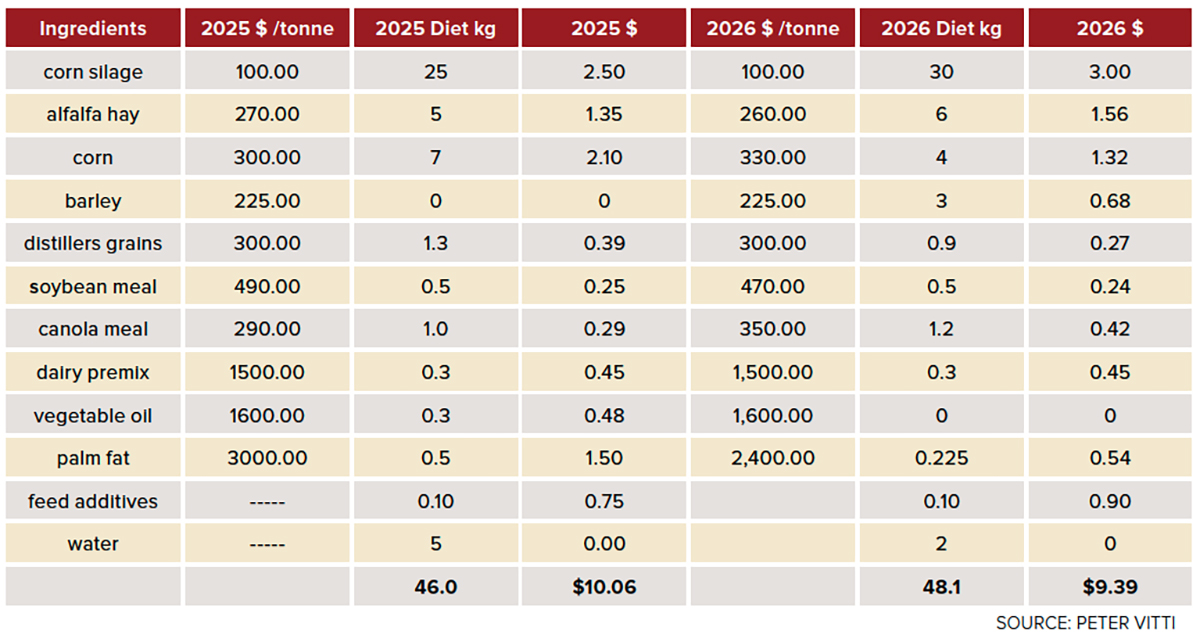
Both 2025 and 2026 lactation diets and their daily costs are illustrated in the accompanying chart.
Needless to say, these diets are also designed to promote good dry matter intake in lactating dairy cows.
I do this by laying a foundation of high-quality forages supplemented with palatable grains and grain byproducts.
A complementary dairy premix is added that contains essential macro-minerals as well as important trace minerals and fat soluble A, D and E vitamins.
Limit-fed by-pass fat and dietary feed additives are formulated in the final dairy diets.
When I see $9.39 spent per day on each lactating cow in 2026 and compare it to the 2025 feed cost, there is a $0.67 per head, or seven percent, savings. This difference translates into about a $20 decrease in the monthly cost of feeding each lactating cow.
It doesn’t seem like much of a decrease, but if a dairy producer milks 200 dairy cows, the real decrease is about $4,000.
Subsequently, the largest 2026 savings in feed costs is due to less grams of palm fat being fed.
Like most commercial dairies, I had followed the mainstream feeding rate by adding “500 grams per head per day” of rumen bypass palm fat to my 2025 lactating dairy total mixed rations.
In doing so, I expect any herd that fed my 2025 diet would have a 0.2 to 0.4 per cent milk fat advantage.
However, with the new focus on producing less kilograms of milk fat, I reduced it to 225 grams. As a result, there was about a $1 feed cost savings and it significantly dropped the percentage of palm fat costs of the entire lactation diet from 15 per cent to a nominal five per cent.
Reducing palm fat in the 2026 diet is really only one way to reduce the cost of feeding lactating dairy cows. Yet, I look for other ways where substantial feed costs might be saved without sacrificing lactation performance.
Here are some cost-saving measures to consider:
- Implement a strong forage foundation. For example, high quality corn silage supplies a significant amount of dietary energy and digestible fibre to support good milk and milk fat. It reduces the need for more expensive grain or off-farm purchases of other feedstuffs.
- Shop for feed protein. With the significant drop in the current price of soybean meal, canola meal and corn distiller grains, it is tempting to buy one or another simply on a lower price. However, when each one is examined for its crude protein/bypass protein content, it may change the final choice of a “better buy.”
- Analyze forages and grains. These feed tests help match their dietary nutrition with the nutrient requirements of high producing lactation cows. It also helps avoid feeding excessive amounts of nutrients. Test moisture of silages and their final TMR diet on a weekly basis.
By using current prices for forages and other feeds and implementing some cost-cutting measures, I can draw a picture as to what it actually costs to feed a lactating dairy cow.
In doing so, I believe dairy producers can format their own true economic feeding budget.