


While pea aphids are aptly named after a crop they affect, they don’t only seek out peas and pulses. They feed on any legume from peas and faba beans to clover and alfalfa across North America, stealing growth essentials and infusing them with viruses.
“They are sucking on the phloem, and so they are stealing nutrients right out of the plant,” said Sean Prager, an associate professor in plant sciences at the University of Saskatchewan, at the Top Crop Summit in Saskatoon.
“Because they’re on the main line, right from the phloem, and that nutrition they’re taking is going into them instead of going into your plant.”
Read Also
Prairie on-farm research programs refine strip-trial methods to deliver clearer results for farmers
Researchers and Prairie farmers are working to improve on-farm strip trials so results from field-scale experiments are clearer, more reliable and easier to use for management decisions.
The longer aphids survive and reproduce, the more plant life is lost.
Crops such as faba beans and lentils can be “demolished” by the insect if left unchecked, and the best way to handle them during large outbreaks is through insecticides.
However, the registered products don’t currently have any recommended thresholds, sampling methods or injury levels, leaving the grower to use it whenever they think best.
Prager and others in his lab decided to better address this by investigating insecticides, their efficacy and timing of application.
They conducted field trials with CDC Snowdrop, a low-tannin faba bean, and CDC Impulse for lentils in 2019 and 2020. Similar results of the trial were found in both legumes, but lentils had a less obvious yield difference.
It was also determined that with faba beans, it doesn’t matter whether they are low or high tannin because the aphids do the same amount of damage on both plants.
The tests involved lambda-cyhalothrin at 100 grams per litre (Matador), a combination product containing lambda-cyhalothrin at 50 grams per litre and chlorantraniliprole at 100 grams per litre (Voliam Express), and cyantraniliprole at 120 grams per litre (Exirel).
Exirel isn’t registered for use in lentils, but it uses systemic activity and was a comparison to the other products that use contact activity.
Each insecticide was tested against plots with base levels of aphids to find the efficacy of each, as well as the damage that each base number of aphids can do to a plot after combining. The goal was to replicate commercial producer practice as much as possible.
“What you can see is, after two days, they all do a pretty alright job of killing,” Prager said.
“But in fact, these two, which have a contact component, work way better initially than systemic incentives. After 10 days, well, it’s still the case that these work better.”
By analyzing the yield, Prager and his team were able to determine an economic injury level and an economic threshold with market price of the crop by dollar per ton, insecticide cost by dollar per acre and number of insects per plant.
It comes down to a lot of math on the back end to determine the final average necessary for the producer to use.
Economic injury level is the “tilting point” where there will be enough insects to create yield loss.
Economic threshold is below, because the goal is to not reach the injury level and to address the issue before potential yield loss grows.
“When you use this number, you’re not going to spray when you don’t have to,” he said.
“That is, you’re not going to waste money spraying when it’s not going to give you a benefit, and you’re also not going to wait too long and lose yield.”
Consistent monitoring is required for crops infested with the pest because they reproduce quickly and multiple times a year, translating to continuous and increased damage if not dealt with. With the threshold table, producers can adjust for potential increases and if they can’t spray right away.
“If, say, 50 aphids is the point where you start getting loss, you might not have 50 aphids now, but two days from now, you might,” he said.
“So, the lead time is important because it accounts for the idea that if you wait, you might get a problem.”
The table can also be used to account for multiple spray applications and insecticide cost because none of the products work well enough to completely get rid of the problem with only one round if early and during the growing season. The exception to this would be if spraying close to harvest, allowing minimal reproduction time.
Producers can determine the best product for efficacy and the economics in finding their individual balance point using Prager’s chart.
Growing concerns
Control of aphids could be a greater issue than first imagined because Prager reported a growing insecticide resistance in the insect.
Beginning in summer 2024, he and other crop pest specialists including James Tansey from Saskatchewan Agriculture and Tyler Wist from Agriculture Canada were receiving calls from producers who had sprayed but seen little to no effect on their populations.
To test their theory, aphids were collected from different locations across the province and the team performed bioassay tests, which at the basic level means the collected bugs were placed in jars with insecticide on a “hot dog roller”. They did the same thing with aphids that have been in Prager’s lab for years.
Of the gathered test subjects, representing the field population, very few died, while the lab subjects were killed at a substantially larger amount.
“It’s a very strong sign that there is insecticide resistance developing,” said Prager.
“And the thing that works best is Matador. It’s the thing that most people spray. And Matador is what we used in these so it’s telling us Matador is losing effect, and that’s since we did those field trials.”
A project to address this and identify tools to offset the growing resistance will be soon underway.
The other risk aphids pose is virus transmission, which has only recently been addressed. It can be difficult to identify because many of the virus’s symptoms can present as herbicide damage or nutrient deficiency.
“Here in the Prairies, we have usually just ignored the idea that they were viruses,” he said.
“The assumption was simply there weren’t viruses. It turns out that was nonsense. They’ve been here forever. It just so happens that you didn’t have someone like me who was willing to go around looking for them.”
During the investigation, Prager and his team mainly looked at pulses but have done the same thing in wheat and to some extent canola.
When plants were pulled, many viruses were found, including:
- Bean leafroll virus (BLRV): Found in pea and chickpea and will cause leaf curling, stunted growth and yellowing.
- Pea streak virus (PeSV): Found in peas and chickpeas and causes mosaic patterns, stunted growth and yellowing.
- Bean yellow mosaic virus (BYMV): Found in peas and causes mosaic patterns, necrosis, leaf curling, stunted growth and yellowing.
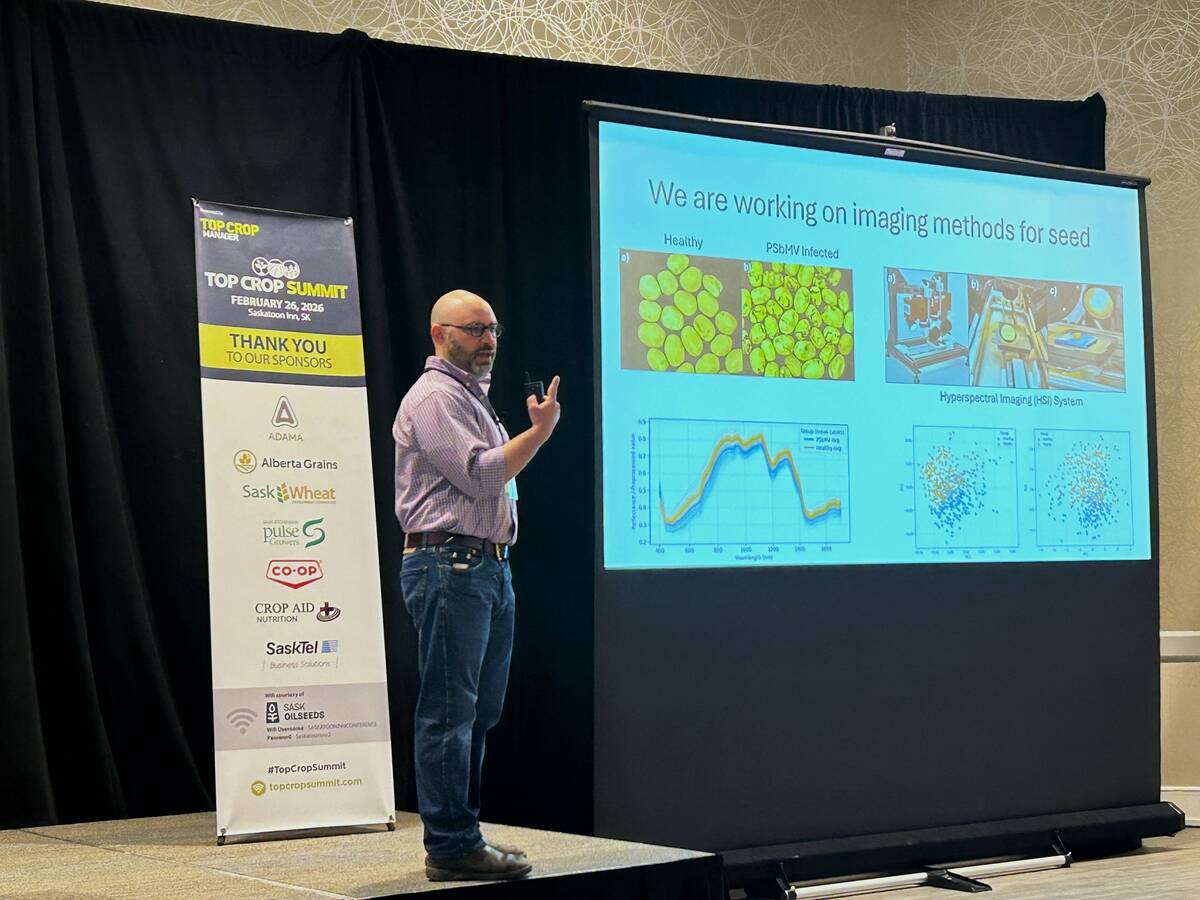
- Pea seedborne mosaic virus (PSbMV): Found in peas, lentils, faba beans and chickpeas causes burning of tendrils, leaf deformation and stunting on chickpea, leaf crinkling and stunted growth. Pea and chickpea seeds may show some marking on the seed coat.
“The one we find, over and over and over, in something like a quarter of all the fields when we start really looking, is pea seedborne mosaic virus,” Prager said.
“And this nasty stuff is really nasty because these seeds are useless. They won’t germinate. You can’t process them. Some of these plants are just going to flat out die.”
An additional risk is that there can often be two viruses in the same plant, such as the pairing of BYMV and PeSV.
Prager’s lab has now developed methods to test for the viruses and he is hoping to begin distributing these to other diagnostic labs such as the provincial ministry soon. The tests are very sensitive and effective at finding the virus.
“They are more sensitive than the COVID tests that they were using at the airport,” he said.
Virus detection can also be done from insects if found, and researchers are working on testing seed to determine if it’s infected before planting through special cameras.