
The Fit to Farm column offers practical, evidence-informed strategies to reduce injury risk, improve mobility and build strength that supports the realities of life on the farm.
Did you know that a small joint you’ve probably never thought much about may be the deciding factor on how well the rest of your body moves?
As a certified athletic therapist, it’s often my job to play detective and search for clues through someone’s body, posture and movement to determine why they are having pain or dysfunction. Often, the area that is at the root of the dysfunction isn’t where the symptoms are presenting. Over the years I’ve learned that starting with the base we move upon, i.e., our feet, is usually the easiest way to avoid a wild goose chase and get people back moving and doing the things they love as quickly as possible.
Read Also
Books Worth the Look, part 2: Kitten and the Bear
A leisurely read through cookbook Kitten and the Bear: Recipes for Small Batch Preserves, Scones and Sweets offers several recipes for marmalde to use up that end-of-winter citrus.
As I’ve mentioned in earlier articles, the micro-movements that happen in our feet significantly influence how the rest of our body moves. Not only do we have thousands of nerve endings in the feet, making them sensory organs in and of themselves, but we also have multitudes of bones and small joints and endless soft tissues. If any of those things aren’t moving or sensing well, we will feel the effects throughout the body.
Because we are mammals who spend the bulk of our movement time ambulating on two feet, everything that happens in those two feet translates through the whole body. Likewise, because our species has evolved to use supporting footwear, our feet are not being used how they were designed to be used. As a result, we are losing valuable mobility and sensitivity.
Our big toe (or if you’re feeling textbook-y, the “first metatarsophalangeal joint”), is made up of four bones: the first metatarsal (what you would reference as the tip of your big toe), the proximal phalanx of the hallux (the bone between the knuckle of the big toe and the ball of the big toe) and two floating bones that are embedded in the tendon underneath the toe, connecting the toe to the rest of the foot.
This joint is designed primarily for flexion (circling the toe back towards the arch of the foot) and extension (lifting the toe up off the ground or back towards the rest of the body). It has a little bit of side-to-side movement as well as rotation. In a perfect world, the normal range of motion for the big toe is between sixty and ninety degrees of extension and between thirty and forty-five degrees of flexion. When walking, we require at least those sixty degrees of extension for efficient gait mechanics. Unfortunately, stiff footwear, such as workboots or tight-fitting shoes, can limit this extension, causing stiff joints.
The big toe is a synovial joint, meaning it has a fluid-lined membrane surrounded by ligaments holding things securely in place. Synovial joints benefit hugely from regular movement, which helps to hydrate the tissues with that lubricating joint fluid. Those two floating bones I mentioned act as pulleys for the tendon, increasing leverage during the push-off phase of walking (propelling us forward) as well as force absorption.
When there are mobility limitations of this joint, we notice pain local to the foot, development of joint degeneration (arthritis) and changes to how the ankle, knee and hip function. If our big toe can’t load and disperse force, our ankle’s movement begins to stiffen and more force gets stuck in the knee and hip, contributing to pain, stiffness and degenerative change in these joints and potentially contributing to spine issues.
I could write a book on all the issues and treatments we can explore in the big toe, but we don’t have enough space here for that. For now, try this exercise regularly:
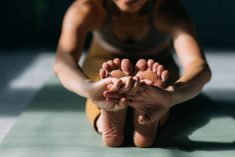
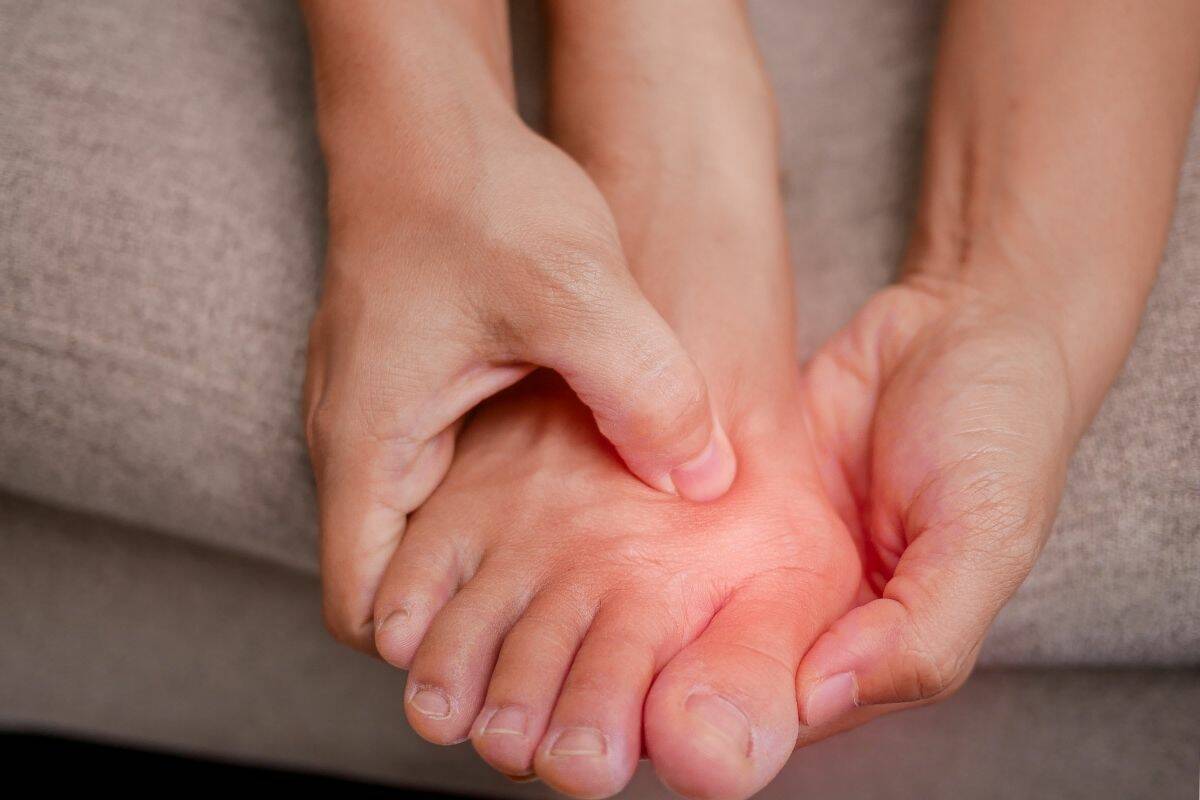
Sitting, use your hands to gently massage around the ball of the big toe and spend time on any tender spots you notice. After about five minutes of gentle massage, grab and secure the toe with one hand and the foot with the other hand and gently traction the toe away from the foot. This is sometimes uncomfortable at first, so go slowly and only as much as you can tolerate. If this feels okay, gently and slowly move the toe in all directions, to whatever degree you are able. Then do the same with the other foot. Repeat ten to fifteen times for a few minutes and end with another few moments of gentle massage around the foot.
Repeating this daily (it makes a great bedtime routine) over the long run can help maintain healthy mobility in the forefoot and potentially save some grief elsewhere in the body. This is especially important if bunions are forming (yes, these are preventable and correctable in many cases), you have a history of foot pain (like plantar fasciitis) or you have noticed increased stiffness in the lower body.
As always, if foot pain is getting in the way of your day-to-day life, it’s important to seek an assessment from a qualified health care provider. Well-trained athletic therapists, physiotherapists and orthopaedic specialists can appropriately assess and guide you toward functional movement and happy feet!