

ST. JEAN BAPTISTE, Man. — Weed experts in multiple states will soon confirm that they have populations of glufosinate-resistant waterhemp.
Aaron Hager, a University of Illinois weed scientist, reported last month that Illinois had several locations where waterhemp had developed resistance to glufosinate, a commonly used herbicide in North America.
Other states in the Midwest have the same problem.
Read Also
Industry shares its thoughts on agriculture policy
At last month’s Agricultural Producers Association of Saskatchewan Policy Summit, various industry heads brought forward ideas that they wanted producers to consider for the agriculture sector’s Next Policy Framework .
“Four states in the U.S. (including Illinois) are all going to come out (soon) with glufosinate-resistant waterhemp,” said Joe Ikley, a weed scientist at North Dakota State University.
Ikley made the comment Jan. 7 at the St. Jean Farm Days, a farm show in Manitoba’s Red River Valley.
The news from the U.S. Midwest is concerning because farmers are running out of options to control waterhemp, a member of the pigweed family. It has already developed resistance to seven different modes of action.
For farmers on the northern Great Plains, it’s a matter of time before waterhemp with resistance to glufosinate is confirmed, Ikley said.
“If it can evolve resistant to a herbicide in Illinois, there’s no reason it can’t do it in North Dakota or the Canadian Prairies.”
Waterhemp was first discovered in Manitoba in 2017, and it’s now present in a wide geography within the province.
It hasn’t been confirmed in Saskatchewan, but weed experts are asking farmers and agronomists to maintain a close watch for the troublesome weed.
While waterhemp is an extremely difficult weed, a bigger risk to western Canadian farmers would be glufosinate-resistant kochia.
In North Dakota, farmers apply glufosinate to 10 million acres of land every year, Ikley said.
So, kochia plants are receiving repeated doses of glufosinate, and resistance is on the horizon.
More North Dakota farmers are reporting escapes, where the herbicide fails to kill a kochia plant. If glufosinate is applied to 100 kochia plants in field and 95 die, the remaining five plants are “escapes.”
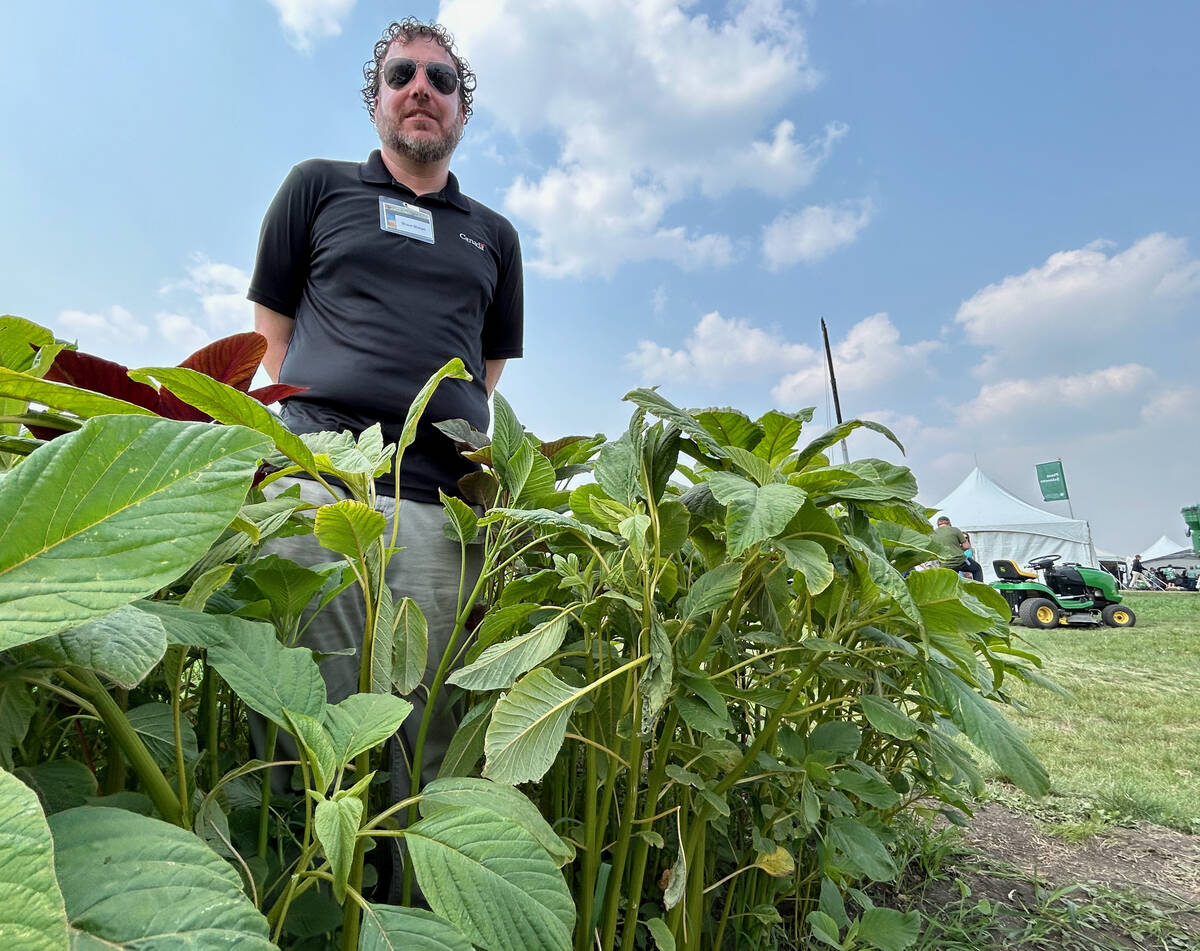
“We see escapes almost every year,” Ikley said.
“Can we prove those ones to be resistant, yet? It’s just a matter of time … until we get a population that is indeed resistant.”
It’s impossible to predict when glufosinate-resistant kochia will arrive in North Dakota or the Prairies.
But Ikley is particularly worried about canola growers, who rely on glufosinate to keep weeds in check.
InVigor hybrids dominate the canola acres in Western Canada, which are genetically modified to have tolerance to glufosinate.
“The issue, when I look at kochia and canola right now, is that the options are glyphosate or glufosinate,” Ikley said.
“And we (already) have widespread glyphosate resistance (in kochia).”
At St. Jean Farm Days, an agronomist delivered a blunt assessment of the risk.
If glufosinate-resistant kochia appears on the Prairies, farmers are “hooped.”